Sheddings
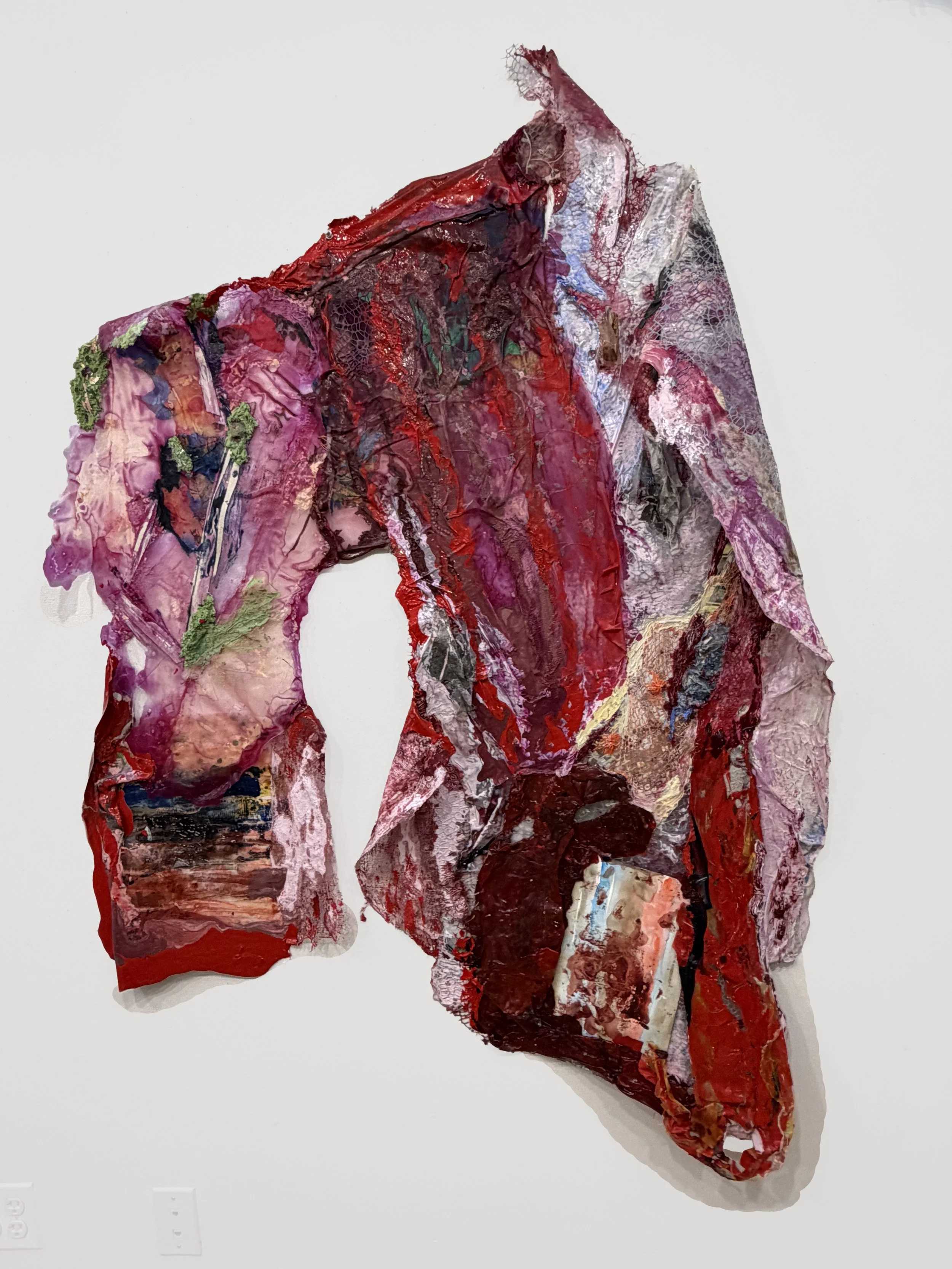
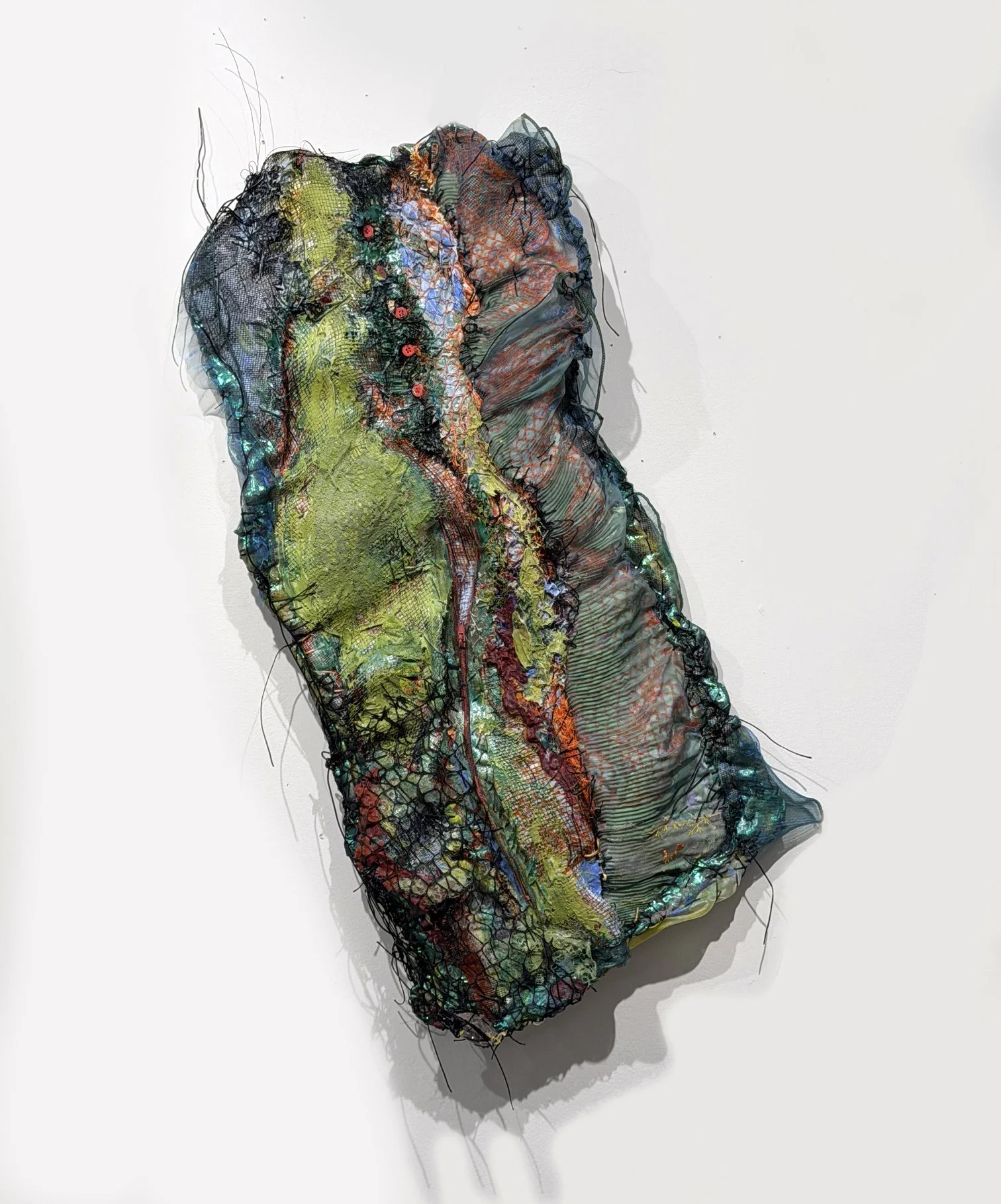
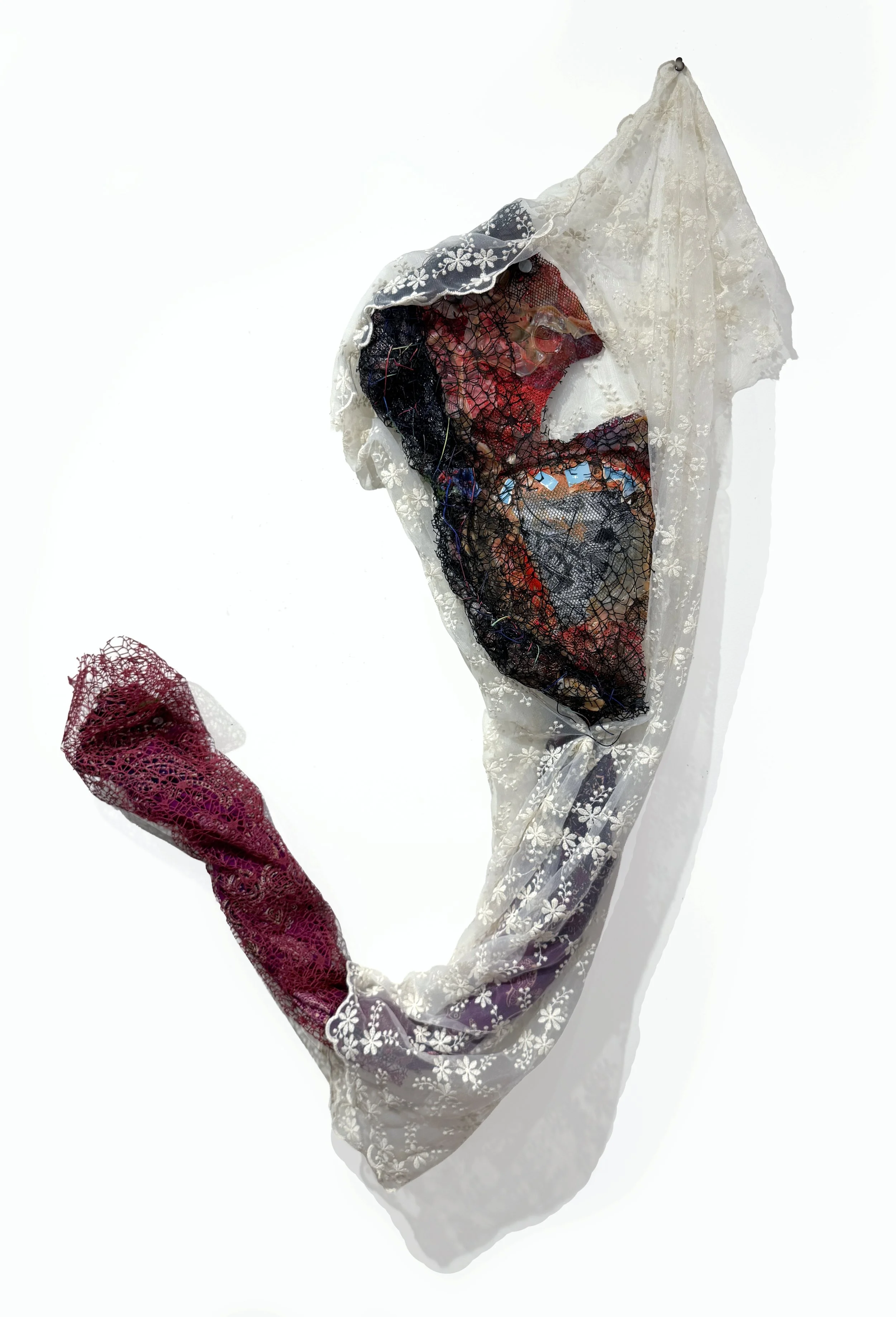
In Sheddings, Etty Yaniv fuses acrylic paint and fragments of discarded textile into thin, pliable membranes. Each holds the shape and folds of a body that is no longer there, like a garment its wearer has stepped out of. The material pulls between weight and air: dense, sagging folds gather downward, while the frayed edges thin into near-transparency. Yaniv works the acrylic by pouring, brushing, and spreading it with a palette knife, fusing it with the found textiles into skins she then tears, hand-sews, and layers. Each piece loosely alludes to a mythological figure: Daphne, Ariadne, Clytemnestra. The skin is what the body leaves behind as it changes form. Hung on the wall or suspended in the air, the works stand together as a group, each a female figure caught mid-transformation.
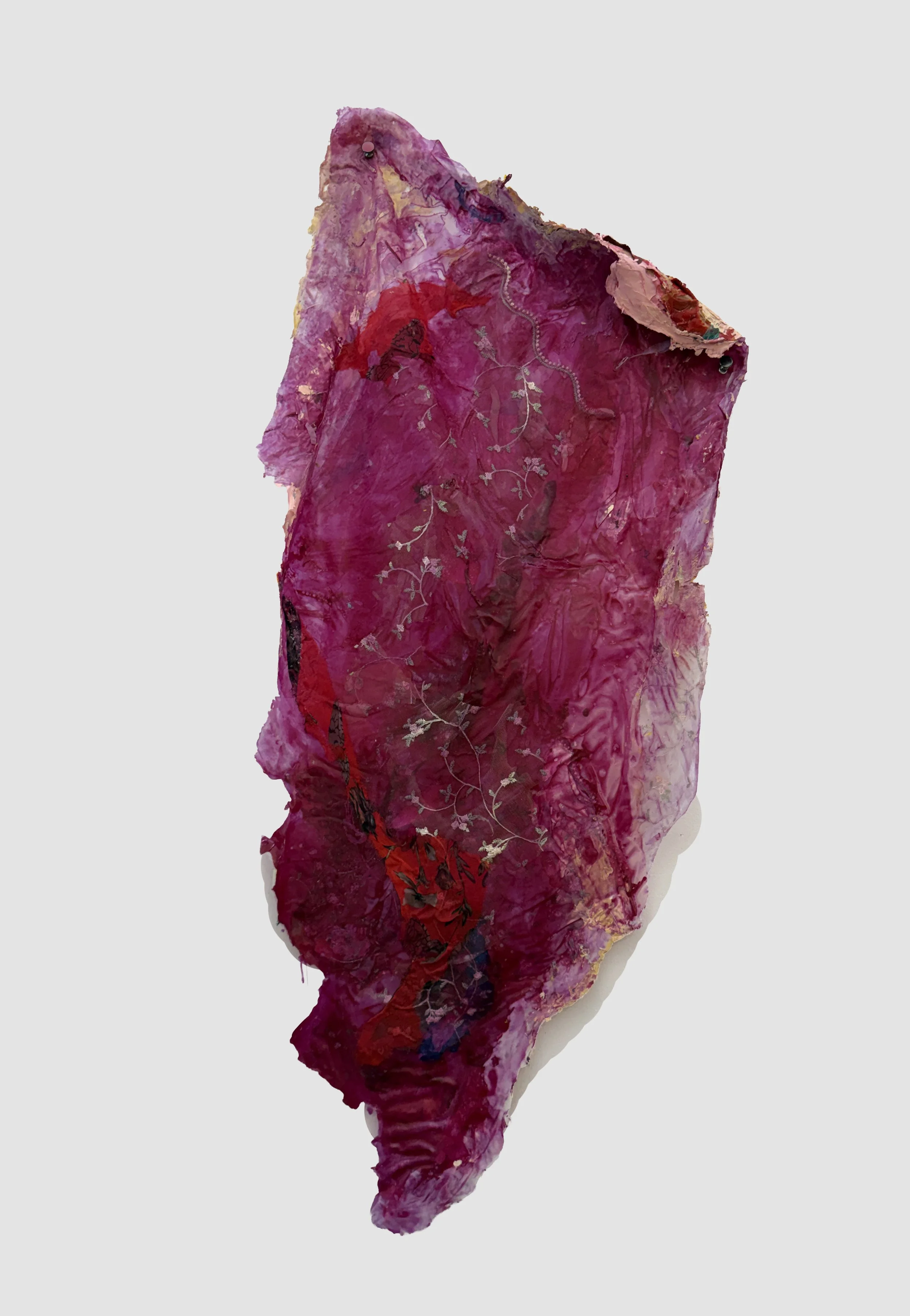
Aphrodite
Textile, acrylic. 2026. 24”x50”.
Aphrodite, the goddess of love and desire, here abstracted as a triangular vulvar shape, falls in love with the beautiful mortal Adonis. When Adonis is fatally wounded while hunting, Aphrodite rushes to him but cannot save him. In some versions of the myth, his blood is transformed into a flower. Here, the embroidered flowers refer to another version in which Aphrodite cuts herself on the thorns of a white rose, and her blood turns its petals red.
Ariadne
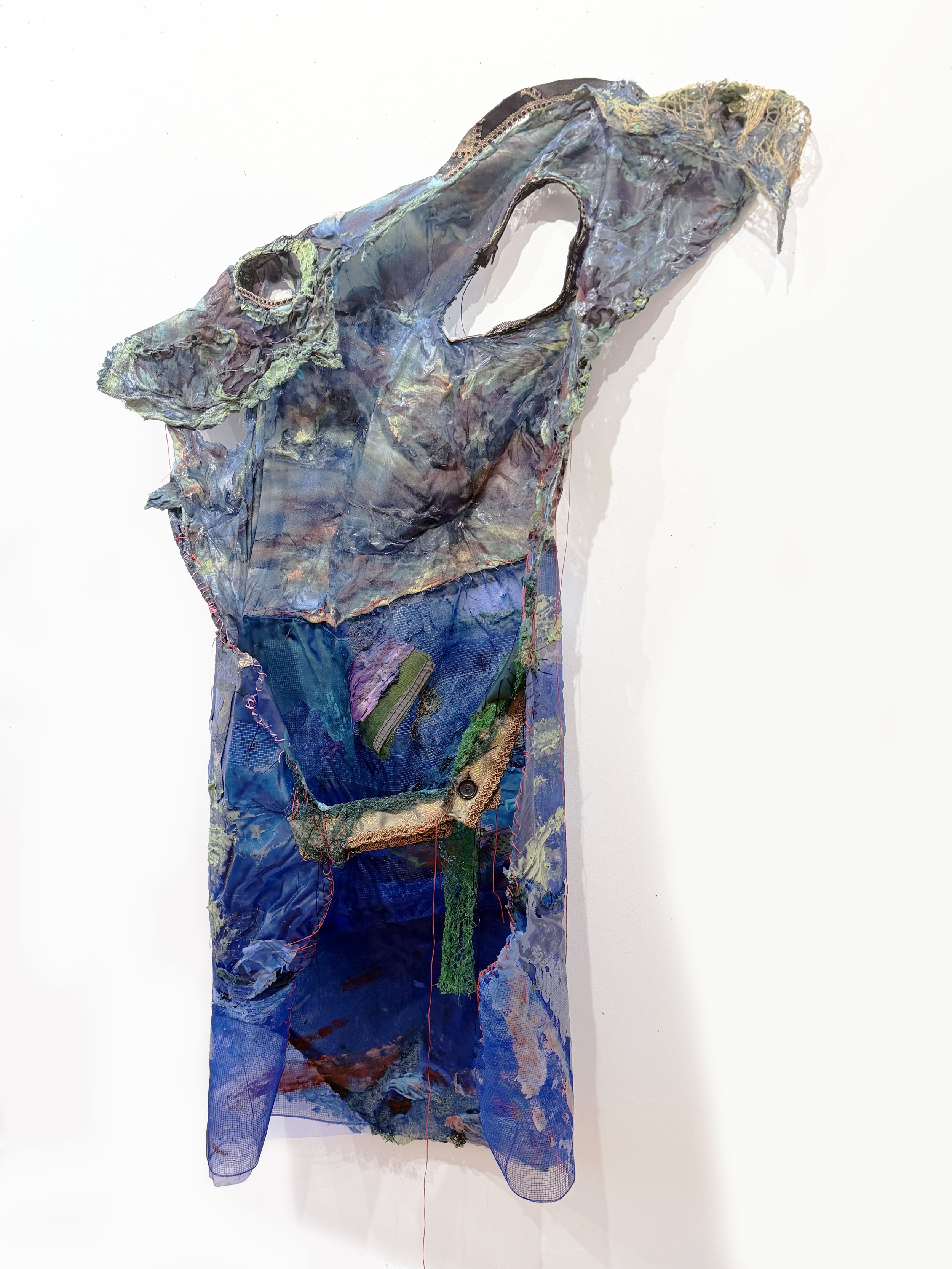
Textile, acrylic. 2026, 32”x56”x6”.
Ariadne is best known for helping Theseus escape the Labyrinth after he kills the Minotaur. She gives him a thread to unwind as he enters, letting him retrace his path through the maze and find his way out. The top of this piece alludes to the maze. After they flee Crete together, Theseus abandons Ariadne on the island of Naxos, surrounded by the Aegean Sea, whose blue-green waters appear at the bottom of the piece. Ariadne's thread ties the two halves together into a story of abandonment and survival.
Calypso
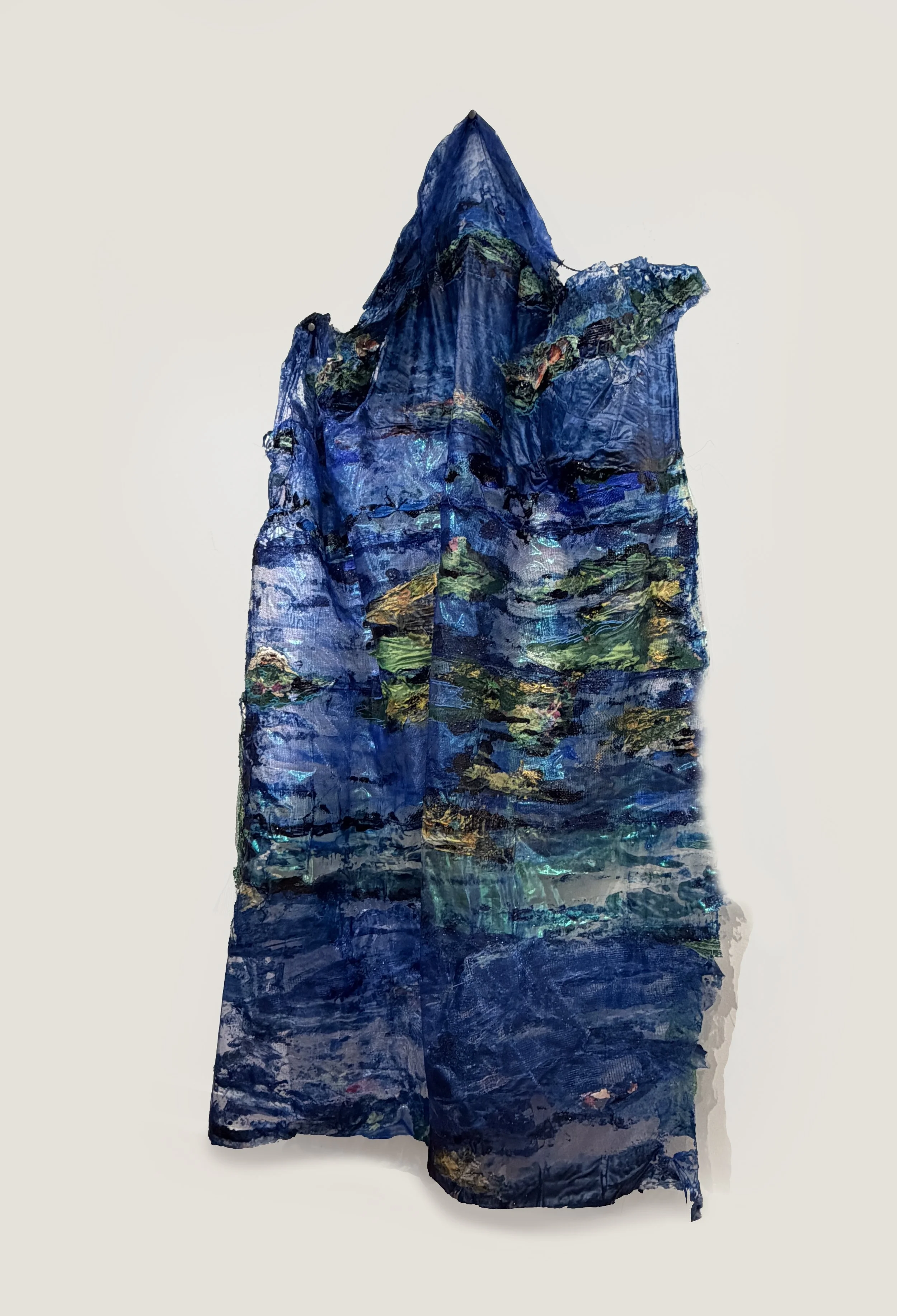
Textile, acrylic. 2026. 76”x43”.
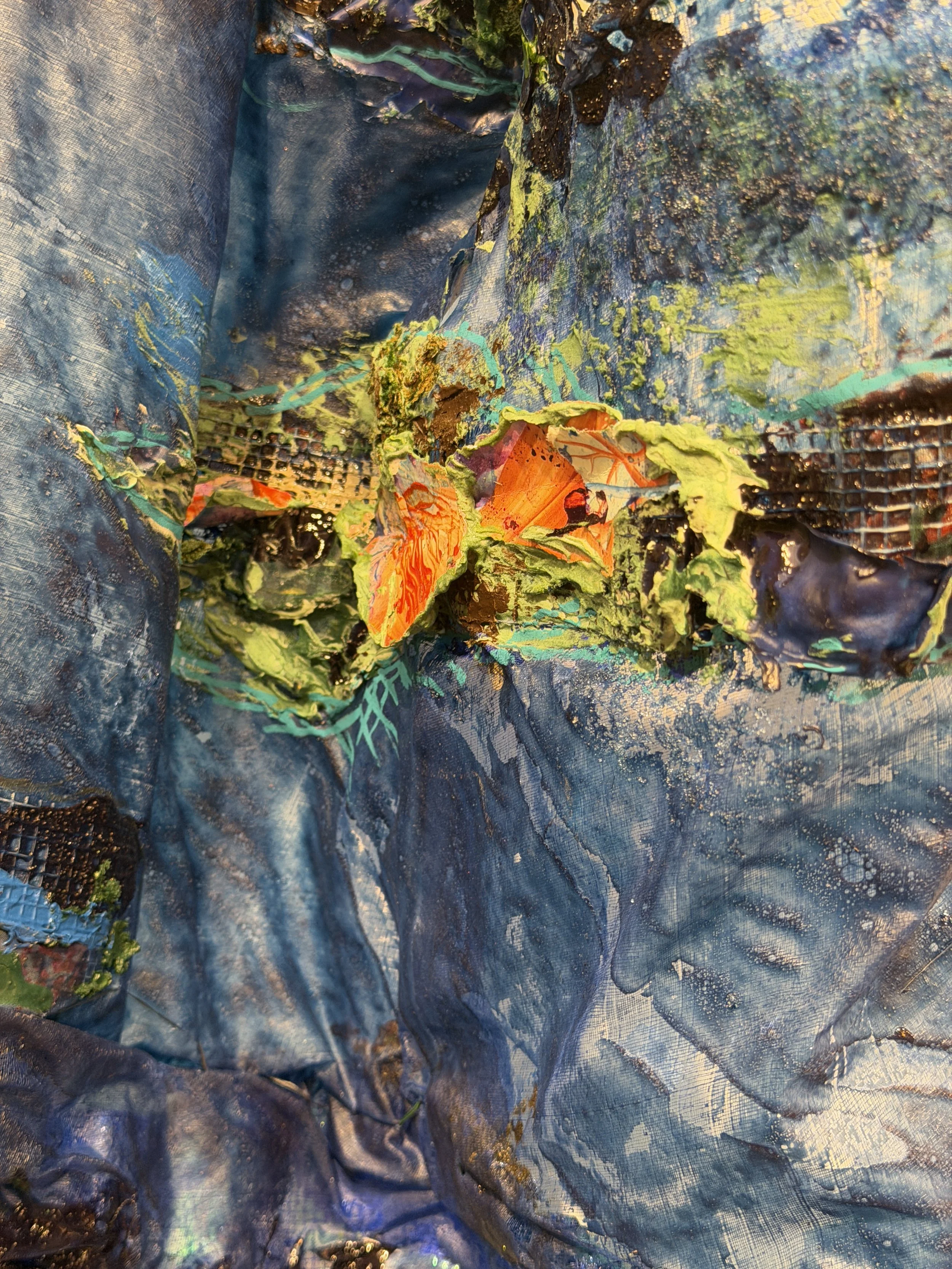
In Homer's Odyssey, the nymph Calypso lives on the remote, mythical island of Ogygia, surrounded by open sea. She is in exile there, banished by Zeus as punishment. Calypso shelters Odysseus after a shipwreck but also allures him to stay with her for seven years. Her island is both refuge and confinement: a lush, protected land cut off from the outside. Calypso's large, cloak-like Shedding reflects this tension between protective embrace and confinement. It offers an alluring safety while keeping Odysseus from returning home. The hooded cape alludes to the ancient Greek kalýptō, "to conceal," reinforcing the association with hiding, enclosure, and shelter. The painted textile, mostly in vibrant blue hues peppered with sparks of bright yellow, cascades downward like sea waves. Some parts are opaque; others transparent, suggesting a depth never fully revealed behind the façade.
Calypso (Detail)
Daphne
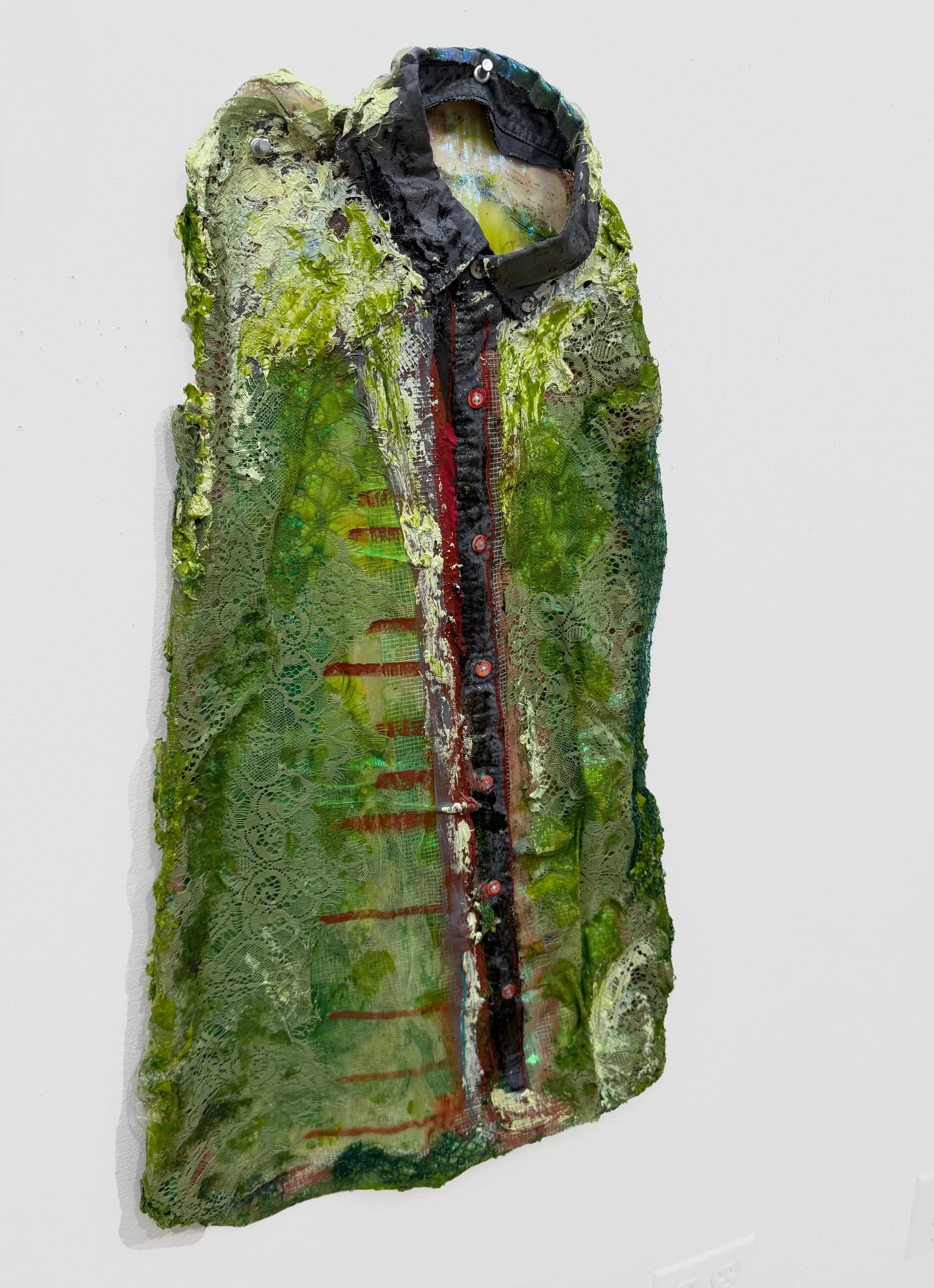
Textile, acrylic. 2026. 17”x23”.
The nymph Daphne is associated with forests, rivers, and the laurel tree. Her best-known story tells of the god Apollo pursuing her despite her attempts to escape him. As Apollo closes in, Daphne calls for help and is transformed into a laurel tree. This piece draws on the idea of human and vegetal states overlapping. The buttoned shirt residue hints at a body, carrying its own history. Covered with growth-like lace, sometimes iridescent, sometimes matte, the piece appears different from each angle, as if in the process of further transformation.
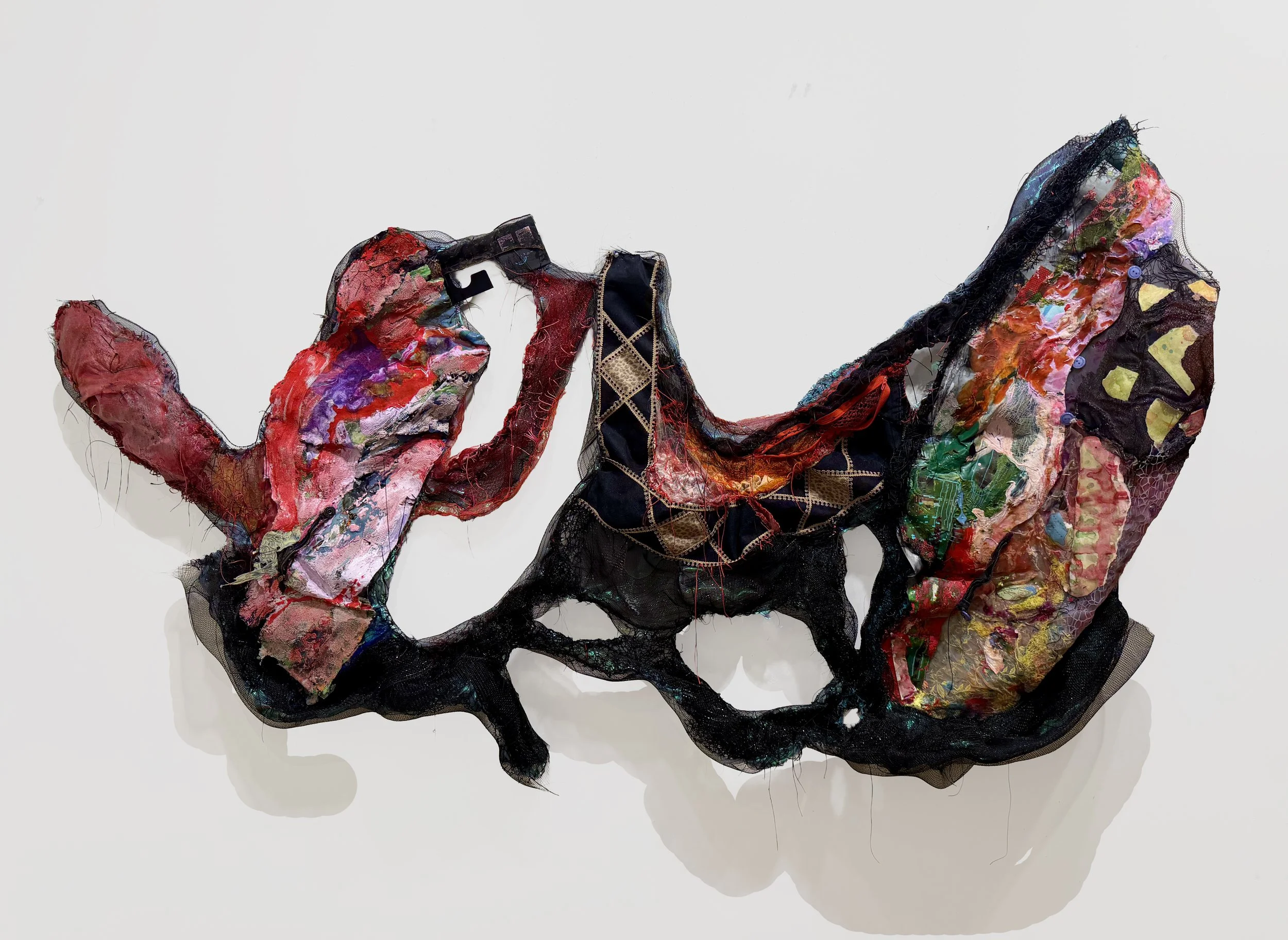
Clytemnestra
Textile, acrylic. 2026. 72”x48”.
When King Agamemnon returns from the Trojan War, his wife Clytemnestra kills him in revenge for the sacrifice of their daughter Iphigenia. She entangles him in a woven cloth that traps him like a net before striking him. Her crimson cloth shifts from a covering into a weapon. The discarded garment in this piece is at times soaked in transparent, dye-like paint, at times built into a dense, gestural surface. Intense reds, pinks, and browns evoke flayed skin, interspersed with abstracted landscapes in greens and blues that allude to the lands and battlefields Agamemnon traversed before his return.
Cyane
Textile, acrylic. 2026. 14”x24”.
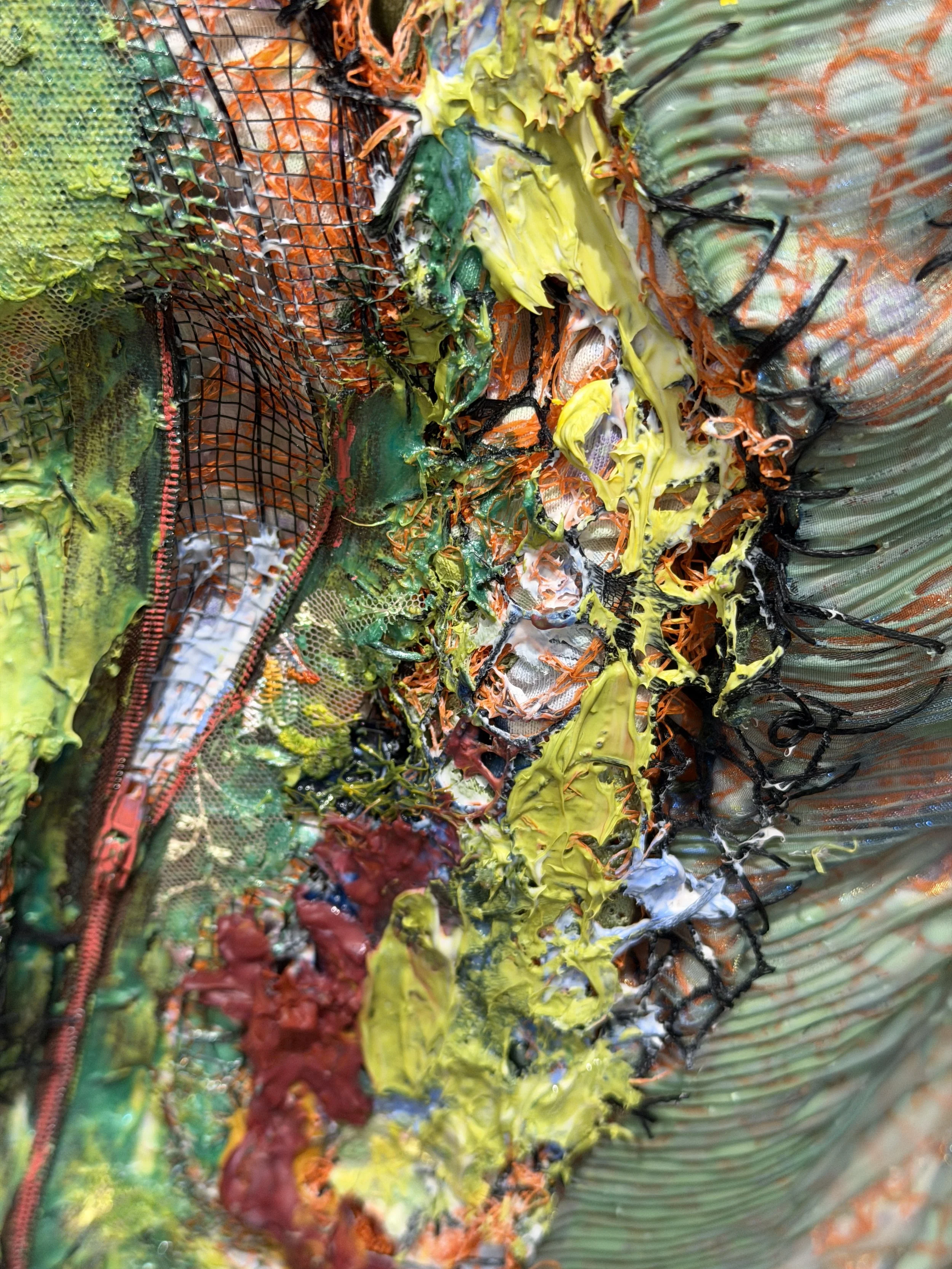
Cyane is a Sicilian water nymph who witnesses Hades abducting Persephone and attempts to stop him. When she cannot prevent the abduction, her grief overwhelms her and she dissolves into the spring she inhabits, her body becoming water. Later, when Demeter searches for her daughter, Cyane can no longer speak, but the water reveals Persephone's belt, lost during the abduction. This piece draws on Ovid's Metamorphoses, in which Cyane's story entwines bodily transformation with landscape. The textile creates iridescent greenish ripples that reveal reddish spots, dark nets, and the residue of a functional garment—buttons that preserve what the body can no longer say. Grief becomes fluid and material, while water becomes both witness and repository, holding the trace of violence.
Cyane (detail)
Penelope
Textile, acrylic. 2026. 50”x40”.
While Odysseus is away, Penelope is pressured by suitors to remarry. She cunningly promises to choose a husband once she finishes weaving a burial shroud, while secretly unraveling each night what she has woven during the day. The unfinished textile allows her to delay the marriage and maintain control over her circumstances, as years of waiting and pressure keep her bound to the same situation. This Shedding draws on Penelope’s mounting frustration, erupting in furious dark reds from her bridal white lace. The piece is made of sewn, painted fragments of found textiles, alluding to Penelope’s daily life of assembling and disassembling.
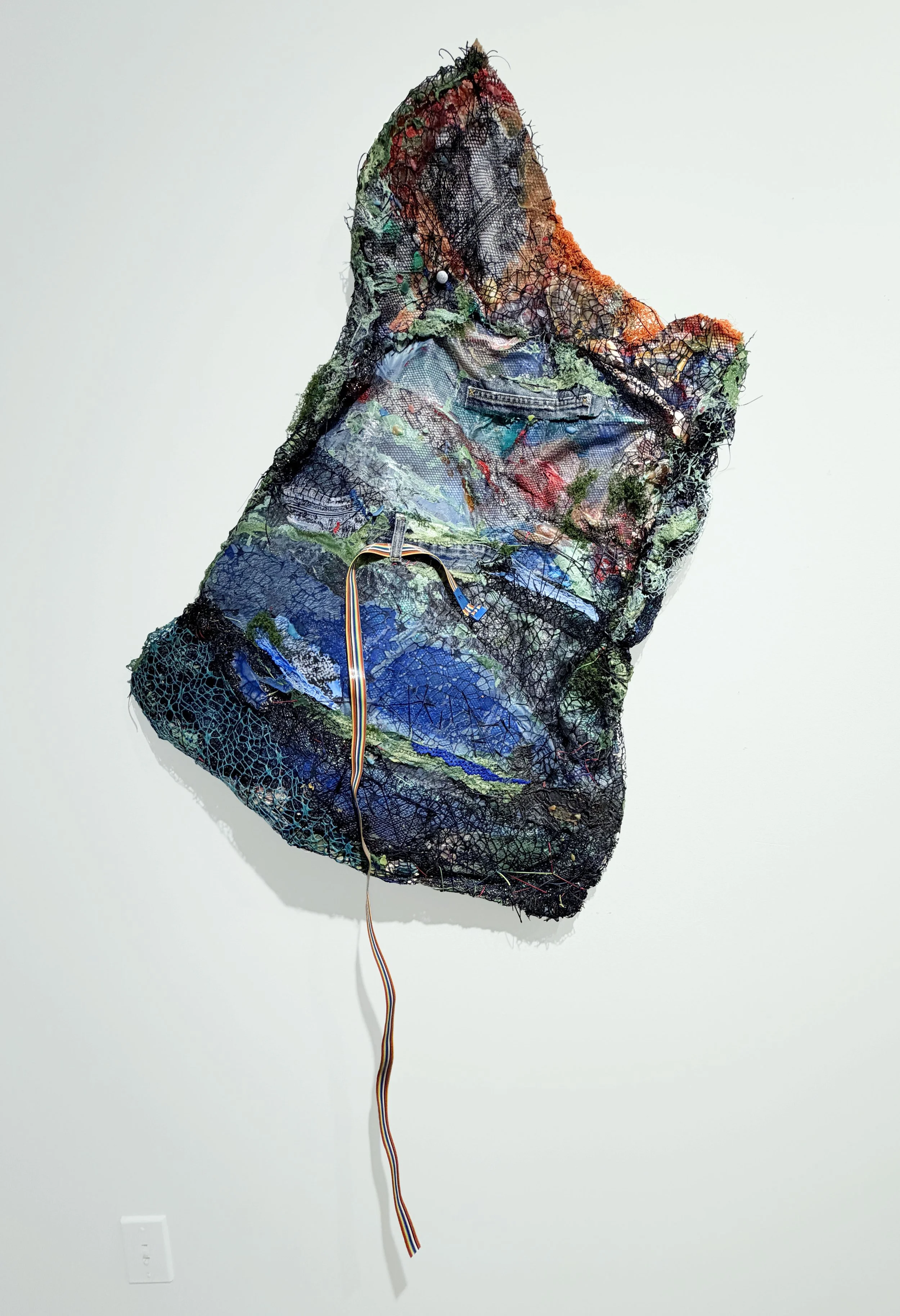
Persephone
Textile, acrylic. 2026. 15”x26”.
Persephone, the daughter of Demeter and Zeus, is gathering flowers when Hades abducts her and takes her to the underworld. Demeter searches for her and in her grief causes the earth to become barren. Persephone eventually returns, but because she has eaten pomegranate seeds in the underworld, she must spend part of each year there. The color palette in this piece, ranging from blues and greens to yellows, reds, and blacks, references the seasonal cycles that mirror Persephone's transitions between the dark underworld and the luminous earth. This cyclical landscape appears on discarded pieces of jeans, suggesting the familiar we take for granted is something wondrous. The cable dangling at the bottom grounds the myth in our present, technological landscape.
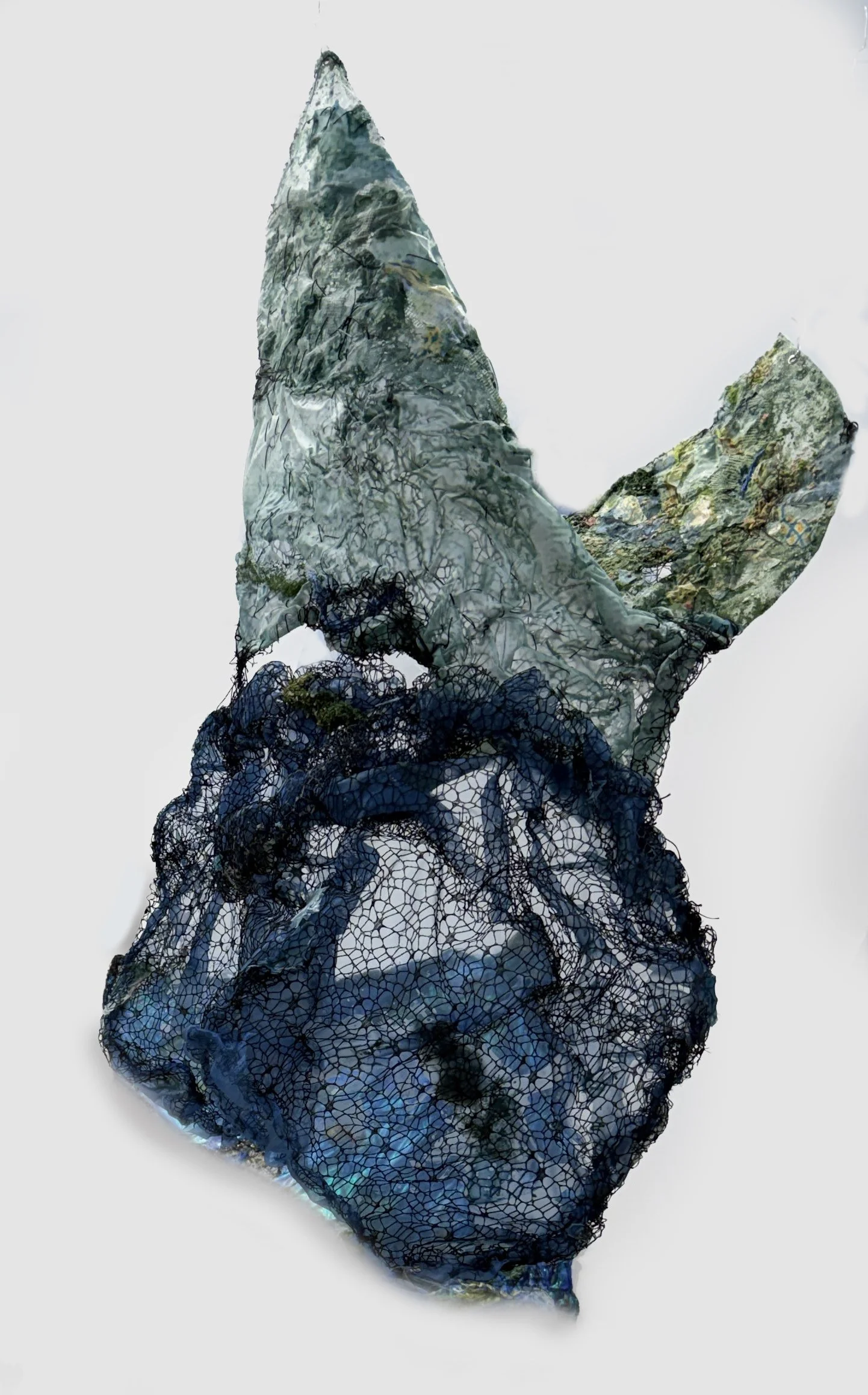
Thetis
Textile, acrylic. 2026. 24”x36”.
When the mortal Peleus tries to capture the sea nymph Thetis, she repeatedly changes form in an attempt to escape him. She becomes water, tree, serpent, and other creatures, shifting from one state to another as Peleus struggles to hold her. This suspended piece, made of paint on nets, draws on series of these fluid shape-shifts through an interplay between dense, detailed areas and light airiness. The nets curve and loop as if in mid-motion, their soft color scheme of deep blues to forest green alluding to a nurturing landscape despite the violent beginning.
The Moirai (The Fates)
Textile, acrylic. 2026. 96”x60”.
Three sister goddesses who spin (Clotho), measure (Lachesis), and cut the threads of human life (Atropos). They are classically depicted as women spinning, wearing stark blood-red or black robes to symbolize death and inevitable fate. This piece abstracts the trio as a symbiotic being, made of threads and paint. Its composition loosely draws on Giorgio Ghisi’s engraving (1558-59), after Giulio Romano's The Three Fates: Clotho, Lachesis and Atropos.